
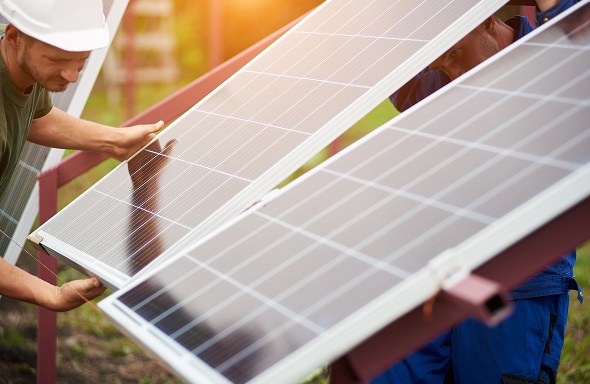
The Colombian energy solutions company expects to close 2025 with revenues close to USD 25 million.
Renewable energy has made significant progress and has had an increasing impact on the way electricity is generated in Colombia. As a result, companies such as SunCompany are investing in new projects aimed at reducing the country’s multidimensional poverty gap.
Under this premise, Portafolio spoke with Juan Diego Gómez, CEO of SunCompany, who shared details about the company’s new projects in Inírida, Colombia, highlighted short-term investment plans, and noted that while the government’s upcoming expansion auction may not be the most successful in history, it is unlikely to fail.
What were the company’s figures over the past year?
“As a company, we have doubled year over year. During the pandemic and the two years that followed, growth was slower. This year, however, we expect to double revenues again, reaching approximately USD 25 million, and by 2026 we aim to double that figure once more.”
How is the holding structure being consolidated?
“The holding was created with two very specific objectives. The first is to gain access to dollar-denominated projects, since much of the financing available for green projects comes in U.S. dollars at favorable rates. This requires balance sheets and revenue streams that allow growth to be dollarized.
The second reason is that, historically, we had been operating through a single business unit that effectively functioned as a holding. SunColombia, which was the operating subsidiary, managed most initiatives internally—somewhat similar to what happened with Bancolombia, keeping proportions in mind.
Now, SunColombia remains the Colombia-focused unit, while all productive and operating units are structured under an international holding. This includes intellectual property, patents, and international business units such as country offices.”
What level of investment was required to take this step?
“We received an investment of USD 15 million through the holding, which is being used to complete the corporate reorganization and to fund growth initiatives.”
What other short-term investment projects are planned?
“Our focus is on what are known as mini-grids and on solutions referred to as behind the meter and in front of the meter.
Behind-the-meter projects are mainly commercial and industrial. In these cases, industrial clients install solar panels and, instead of relying on diesel backup generators, deploy battery systems. Front-of-the-meter solutions apply to different use cases; our most specific example is in the Dominican Republic, where we will provide auxiliary services to the electricity grid using batteries.
These solutions are not yet regulated in Colombia, but they are in other countries where we operate. The goal is to place these assets at the service of the national interconnected system, helping to resolve issues such as grid instability and frequency drops.”
How is the investment distributed?
“In the Dominican Republic, the first asset represents an investment of USD 10 million, while in Guyana we are looking at USD 5 million.
In Colombia, we have just launched the construction of the country’s largest mini-grid in Inírida, with an investment of approximately USD 20 million.”
What is expected from the Inírida project?
“It is a public–private partnership in which the private developer sells energy to an off-taker—a national public utility company. This utility already operated an initial concession, known as Inírida 1, which has been in place for five years. The government, as any utility would, sets a fixed purchase price for the energy.
Payments are made for both the solar generation and the battery energy, while the private developer assumes 100% of the asset risk. In return, the state guarantees the purchase of the energy produced.
The project will reduce diesel consumption by more than half, significantly lowering costs. In Colombia, diesel subsidies in remote areas represent a major fiscal burden, which renewable energy can help alleviate.”
Why continue investing in Colombia?
“I believe Colombia is a very resilient country—there is always work to be done and always projects underway. The scale of multidimensional poverty is enormous, and that is precisely why continued investment is needed to close this gap.
The country requires substantial private investment. The state alone cannot support everything that is needed to uplift the base of the pyramid that urgently needs opportunities to progress.”
How do you expect the government’s new expansion auction to perform?
“I don’t believe the auction will fail, because energy is essential. Past auctions attracted international players who ultimately performed well, even if they later exited the country by selling their portfolios.
That said, there are risks—most notably the significant delays in transmission infrastructure. You can’t have a chair without a horse; the horse, in this case, is transmission.
The biggest challenge for the auction’s success is avoiding a repeat of the previous one, where transmission lines were promised, developers invested heavily, and the infrastructure has yet to materialize.
If transmission is handled properly, there is ample room for energy transition and generation, and it sends a clear signal that Colombia remains an attractive destination for investment. So, it won’t turn out badly—but it won’t be the most successful auction in history either, due to the lack of solid transmission foundations.”
Have you considered other energy generation sources?
“We have conducted several pilot projects with small-scale wind energy for intermittent generation. Wind power has proven effective at large scale in other countries—projects of 3, 5, or 6 MW and above.
Looking ahead to 2026 and 2027, our focus will be on developing two patents and business units that had been on hold. One of these is a hydroturbine company that generates energy through water supply pipelines, which can be hybridized with other technologies, such as micro-hydropower plants.”
Leidy Julieta Ruiz Clavijo
Enlace noticia: https://www.portafolio.co/energia/entrevista-con-juan-diego-gomez-ceo-de-suncompany-640131
Autor: Comunicado de Prensa – portafolio